
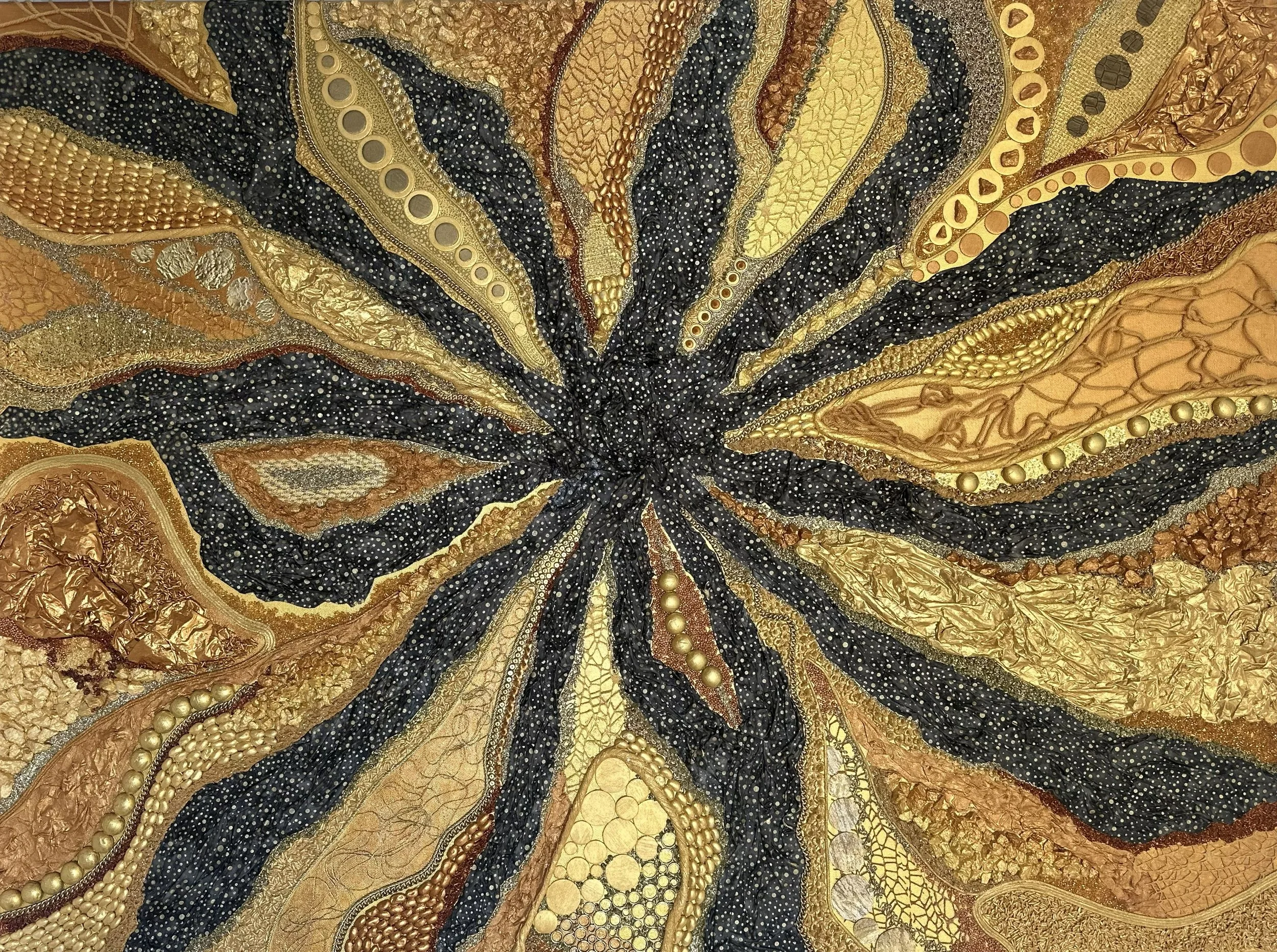
Twenty Five Percent
36” x 48”
Acrylic Paint, Pumice, Metallic Paint, Beans, Rice, Chain, Metallic Wired Cord, Metallic Thread, Beads, Fabric, Cheese Cloth, Glass, Elastic Cord, Rocks, Wood, Sponge, Plastic Bags, Metallic Wired Ribbon, Glitter, Art Prints, Photos, Mesh Ribbon, Gauze, Yarn, Burlap, Metal, Faux Leather on Stretched Canvas
2023
This mixed‑media work confronts the violent rupture of the Trans‑Atlantic Slave Trade through a composition that stages a dramatic struggle between darkness and light. It was created using acrylic paint and a myriad of non-conventional mixed-media materials as a reference to the Artist’s ancestors developing a rich and diverse culture with limited materials. The piece radiates outward from a shadowed core. Its gold, bronze, and black textures collide like fractured histories, with the darkness pressing into the light, the light refusing to disappear.
The title references two intertwined truths shaped by the legacy of enslavement. Historically, mortality during the Middle Passage often reached up to twenty‑five percent on certain routes and in earlier centuries, illustrating a staggering loss of life that represents not only individuals stolen but cultures disrupted, families severed, and futures rewritten. At the same time, genetic studies show that African‑Americans today carry, on average, about twenty‑five percent European ancestry, a direct result of the systemic sexual violence, coercion, and power imbalance embedded within the institution of slavery. The number becomes a haunting echo of a statistic of death and a statistic of survival, both born from the same historical wound.
Chains, cords, and metallic elements embedded in the work evoke the physical and psychological bondage of enslavement, while the layered, almost geological textures suggest the weight of generational trauma sedimented over time. Yet within this darkness, the materials also speak to resilience. The use of everyday, humble items such as beans, rice, fabric scraps, plastic, and wood, reflects the ways African‑Americans transformed limited resources into a dynamic, enduring culture. These materials honor the creativity born from constraint, the beauty shaped from scarcity, and the ingenuity that has defined Black survival and expression for centuries.
The inclusion of non‑perishable food items such as rice and beans also gestures toward the ongoing crisis of food insecurity in under‑resourced communities across the United States. Their presence ties past deprivation to present inequity, underscoring how the legacies of the Trans‑Atlantic Slave Trade continue to shape lived experience.
Twenty‑Five Percent was awarded Juror’s Choice at a recent exhibition with the Maryland Federation of Art in Annapolis, Maryland, a recognition that affirms both the emotional gravity of the work and the power of its material storytelling. Through its radiating forms, dense textures, and symbolic contrasts, the piece becomes a meditation on loss, endurance, and the persistent glow of a people who continue to create light from the deepest dark.
36” x 48”
Acrylic Paint, Pumice, Metallic Paint, Beans, Rice, Chain, Metallic Wired Cord, Metallic Thread, Beads, Fabric, Cheese Cloth, Glass, Elastic Cord, Rocks, Wood, Sponge, Plastic Bags, Metallic Wired Ribbon, Glitter, Art Prints, Photos, Mesh Ribbon, Gauze, Yarn, Burlap, Metal, Faux Leather on Stretched Canvas
2023
This mixed‑media work confronts the violent rupture of the Trans‑Atlantic Slave Trade through a composition that stages a dramatic struggle between darkness and light. It was created using acrylic paint and a myriad of non-conventional mixed-media materials as a reference to the Artist’s ancestors developing a rich and diverse culture with limited materials. The piece radiates outward from a shadowed core. Its gold, bronze, and black textures collide like fractured histories, with the darkness pressing into the light, the light refusing to disappear.
The title references two intertwined truths shaped by the legacy of enslavement. Historically, mortality during the Middle Passage often reached up to twenty‑five percent on certain routes and in earlier centuries, illustrating a staggering loss of life that represents not only individuals stolen but cultures disrupted, families severed, and futures rewritten. At the same time, genetic studies show that African‑Americans today carry, on average, about twenty‑five percent European ancestry, a direct result of the systemic sexual violence, coercion, and power imbalance embedded within the institution of slavery. The number becomes a haunting echo of a statistic of death and a statistic of survival, both born from the same historical wound.
Chains, cords, and metallic elements embedded in the work evoke the physical and psychological bondage of enslavement, while the layered, almost geological textures suggest the weight of generational trauma sedimented over time. Yet within this darkness, the materials also speak to resilience. The use of everyday, humble items such as beans, rice, fabric scraps, plastic, and wood, reflects the ways African‑Americans transformed limited resources into a dynamic, enduring culture. These materials honor the creativity born from constraint, the beauty shaped from scarcity, and the ingenuity that has defined Black survival and expression for centuries.
The inclusion of non‑perishable food items such as rice and beans also gestures toward the ongoing crisis of food insecurity in under‑resourced communities across the United States. Their presence ties past deprivation to present inequity, underscoring how the legacies of the Trans‑Atlantic Slave Trade continue to shape lived experience.
Twenty‑Five Percent was awarded Juror’s Choice at a recent exhibition with the Maryland Federation of Art in Annapolis, Maryland, a recognition that affirms both the emotional gravity of the work and the power of its material storytelling. Through its radiating forms, dense textures, and symbolic contrasts, the piece becomes a meditation on loss, endurance, and the persistent glow of a people who continue to create light from the deepest dark.