
Paradise
36” x 48”
Acrylic, Fabric, Paper, Beads, Glitter, Freshwater Pearls, Metal, Cord, Wood, Rice, Faux Feathers, Chain, Styrofoam, Gel Pen, Pumice, Oil Pastel, Ground Coffee on Stretched Canvas
2026
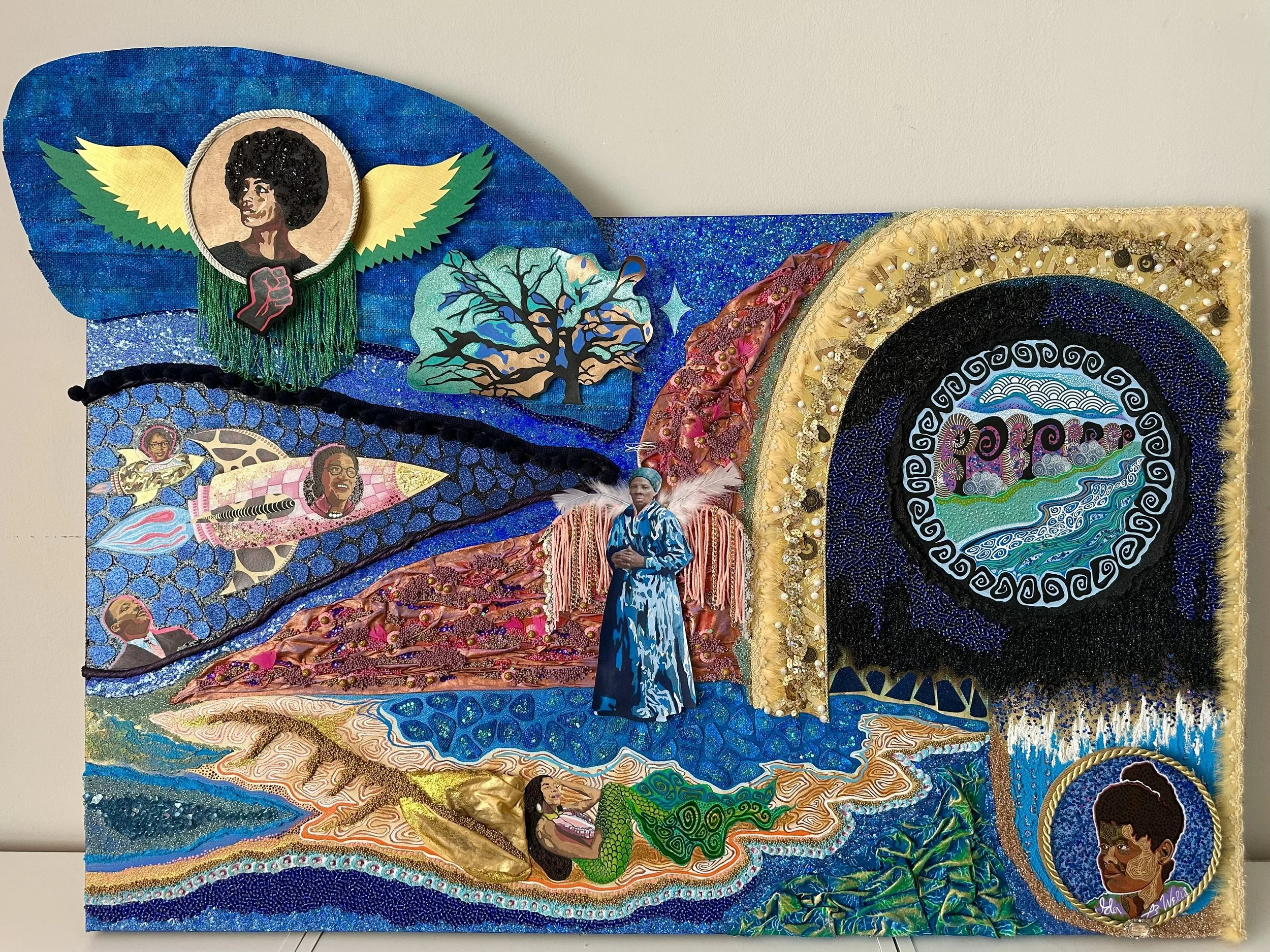
Paradise is a mixed‑media constellation of history, fantasy, and liberation, bringing together iconic civil rights figures across time, space, and imagined worlds. Created with acrylic paint, fabric, paper, beads, glitter, freshwater pearls, metal, cord, wood, rice, faux feathers, chain, styrofoam, gel pen, pumice, oil pastel, and ground coffee on stretched canvas, the piece fuses portraiture, sculpture, and speculative storytelling into a single, multidimensional landscape. It reimagines Black freedom not only as a historical struggle, but as a cosmic, intergenerational journey. One in which Black women lead, ascend, and transcend.
At the top left, Angela Davis appears on a wooden disc, her hair textured with ground coffee and framed by the raised Black Panther fist. She stands as a symbol of radical clarity and resistance, her presence anchoring the piece in the intellectual and political force of Black liberation movements.
Beside her, a glittering paper rendering of the Emancipation Oak, the historic tree on the campus of Hampton University in Hampton, Virginia, becomes a shimmering emblem of education, emancipation, and collective memory. The oak is believed to be more than 200 years old and stands as one of the most important living monuments to freedom in the United States. Beneath its sprawling branches, in 1861, Mary S. Peake, a free Black teacher working with the American Missionary Association, held her first classes for formerly enslaved people who had sought refuge at nearby Fort Monroe. Two years later, in 1863, the first Southern reading of President Abraham Lincoln’s Emancipation Proclamation took place under this same tree, giving it its name. The Emancipation Oak continues to symbolize the power of education and community as tools of liberation and a living witness to the transformation of knowledge into freedom.
Below them, Martin Luther King Jr. watches as Rosa Parks and Claudette Colvin lift off in spaceships, joyfully ascending beyond the constraints of segregation and the violence of the bus system that once denied them dignity. Their flight is both humorous and profound. A feminist reframing that de-centers men from the civil rights narrative and imagines Black women choosing their own vehicles of liberation. In the spirit of forget your bus, I’m on a spaceship, they rise beyond gravity, beyond racism, beyond the limits imposed upon them.
At the center of the composition stands Harriet Tubman, elevated above a sculpted terrain of fabric, beads, and faux flowers. She wears wings crafted from gold wire, pink yarn, and gold chains, which are symbols of both the bondage she escaped and the freedom she carved for others. Behind her, a second set of white wings casts her as an angelic guide, a protector across realms. Tubman’s face is the only photographic image in the piece, grounding her in reality even as she moves through a world of fantasy and time travel. She stands on water collaged with burlap and glitter over metallic blue acrylic, evoking both the perilous crossings she led and the spiritual depth of her journey.
In the foreground, Assata Shakur appears as a mermaid resting freely on a Cuban shoreline, illustrating a vision of refuge, reclamation, and self‑determined life beyond the reach of the state. Her presence expands the piece’s cosmology, linking the oceanic mythologies of Black diaspora to contemporary political exile.
On the bottom right, Ida B. Wells is painted on another wooden disc, outlined in red in reference to The Red Record, her groundbreaking documentation of lynching in America. Her signature appears below her, honoring her legacy as a writer, investigator, and truth‑teller whose pen reshaped national consciousness.
Each figure in Paradise is bound by a shared lineage of resistance, truth‑telling, and transformation. Angela Davis and Assata Shakur, both members of the Black Panther Party, embody the radical courage required to confront systems of oppression headon. Davis’s advocacy for Shakur during her imprisonment underscores the solidarity between women who refused to be silenced by a legal system that often functions as a modern extension of slavery, serving as a mechanism of control, punishment, and erasure. Shakur’s persecution, marked by stacked charges and the threat of execution, mirrors the historical violence that Ida B. Wells fought against decades earlier when she exposed the false narratives surrounding lynching and insisted that those murdered were not guilty, but victims of racial terror.
Harriet Tubman’s leadership on the Underground Railroad and Rosa Parks’s defiance on a segregated bus both represent acts of movement, both literal and spiritual, toward freedom, while Claudette Colvin’s earlier stand reminds us that liberation is often born from youthful bravery. Together, these women form a constellation of struggle and survival, each illuminating the next. Their stories converge in Paradise as a vision of collective ascension. This is a world where the fight for justice transcends time, geography, and even gravity itself.
Threaded through the work is a sculpted portal that resembles both a cosmic gateway and a train tunnel carved through a mountain, serving as a dual reference to the Underground Railroad and the imaginative possibilities of time travel. The portal is framed by an assemblage of gold paper strips, fur trim, embroidery, and tiny golden clocks, suggesting the collapse of linear time and the persistence of ancestral memory. Its dark interior, built from beads and rice, holds an abstract shoreline painting at its center. This is a place of arrival, departure, or dream.
Across the piece, the blending of realism, fantasy, and myth reframes liberation as something expansive, nonlinear, and deeply imaginative. Paradise becomes a world where Black women are not only remembered, but exalted; not only grounded in history, but free to soar across galaxies, oceans, and eras. It is a vision of freedom that is cosmic, joyful, and unapologetically centered on the women who have always carried the movement forward.
36” x 48”
Acrylic, Fabric, Paper, Beads, Glitter, Freshwater Pearls, Metal, Cord, Wood, Rice, Faux Feathers, Chain, Styrofoam, Gel Pen, Pumice, Oil Pastel, Ground Coffee on Stretched Canvas
2026
Paradise is a mixed‑media constellation of history, fantasy, and liberation, bringing together iconic civil rights figures across time, space, and imagined worlds. Created with acrylic paint, fabric, paper, beads, glitter, freshwater pearls, metal, cord, wood, rice, faux feathers, chain, styrofoam, gel pen, pumice, oil pastel, and ground coffee on stretched canvas, the piece fuses portraiture, sculpture, and speculative storytelling into a single, multidimensional landscape. It reimagines Black freedom not only as a historical struggle, but as a cosmic, intergenerational journey. One in which Black women lead, ascend, and transcend.
At the top left, Angela Davis appears on a wooden disc, her hair textured with ground coffee and framed by the raised Black Panther fist. She stands as a symbol of radical clarity and resistance, her presence anchoring the piece in the intellectual and political force of Black liberation movements.
Beside her, a glittering paper rendering of the Emancipation Oak, the historic tree on the campus of Hampton University in Hampton, Virginia, becomes a shimmering emblem of education, emancipation, and collective memory. The oak is believed to be more than 200 years old and stands as one of the most important living monuments to freedom in the United States. Beneath its sprawling branches, in 1861, Mary S. Peake, a free Black teacher working with the American Missionary Association, held her first classes for formerly enslaved people who had sought refuge at nearby Fort Monroe. Two years later, in 1863, the first Southern reading of President Abraham Lincoln’s Emancipation Proclamation took place under this same tree, giving it its name. The Emancipation Oak continues to symbolize the power of education and community as tools of liberation and a living witness to the transformation of knowledge into freedom.
Below them, Martin Luther King Jr. watches as Rosa Parks and Claudette Colvin lift off in spaceships, joyfully ascending beyond the constraints of segregation and the violence of the bus system that once denied them dignity. Their flight is both humorous and profound. A feminist reframing that de-centers men from the civil rights narrative and imagines Black women choosing their own vehicles of liberation. In the spirit of forget your bus, I’m on a spaceship, they rise beyond gravity, beyond racism, beyond the limits imposed upon them.
At the center of the composition stands Harriet Tubman, elevated above a sculpted terrain of fabric, beads, and faux flowers. She wears wings crafted from gold wire, pink yarn, and gold chains, which are symbols of both the bondage she escaped and the freedom she carved for others. Behind her, a second set of white wings casts her as an angelic guide, a protector across realms. Tubman’s face is the only photographic image in the piece, grounding her in reality even as she moves through a world of fantasy and time travel. She stands on water collaged with burlap and glitter over metallic blue acrylic, evoking both the perilous crossings she led and the spiritual depth of her journey.
In the foreground, Assata Shakur appears as a mermaid resting freely on a Cuban shoreline, illustrating a vision of refuge, reclamation, and self‑determined life beyond the reach of the state. Her presence expands the piece’s cosmology, linking the oceanic mythologies of Black diaspora to contemporary political exile.
On the bottom right, Ida B. Wells is painted on another wooden disc, outlined in red in reference to The Red Record, her groundbreaking documentation of lynching in America. Her signature appears below her, honoring her legacy as a writer, investigator, and truth‑teller whose pen reshaped national consciousness.
Each figure in Paradise is bound by a shared lineage of resistance, truth‑telling, and transformation. Angela Davis and Assata Shakur, both members of the Black Panther Party, embody the radical courage required to confront systems of oppression headon. Davis’s advocacy for Shakur during her imprisonment underscores the solidarity between women who refused to be silenced by a legal system that often functions as a modern extension of slavery, serving as a mechanism of control, punishment, and erasure. Shakur’s persecution, marked by stacked charges and the threat of execution, mirrors the historical violence that Ida B. Wells fought against decades earlier when she exposed the false narratives surrounding lynching and insisted that those murdered were not guilty, but victims of racial terror.
Harriet Tubman’s leadership on the Underground Railroad and Rosa Parks’s defiance on a segregated bus both represent acts of movement, both literal and spiritual, toward freedom, while Claudette Colvin’s earlier stand reminds us that liberation is often born from youthful bravery. Together, these women form a constellation of struggle and survival, each illuminating the next. Their stories converge in Paradise as a vision of collective ascension. This is a world where the fight for justice transcends time, geography, and even gravity itself.
Threaded through the work is a sculpted portal that resembles both a cosmic gateway and a train tunnel carved through a mountain, serving as a dual reference to the Underground Railroad and the imaginative possibilities of time travel. The portal is framed by an assemblage of gold paper strips, fur trim, embroidery, and tiny golden clocks, suggesting the collapse of linear time and the persistence of ancestral memory. Its dark interior, built from beads and rice, holds an abstract shoreline painting at its center. This is a place of arrival, departure, or dream.
Across the piece, the blending of realism, fantasy, and myth reframes liberation as something expansive, nonlinear, and deeply imaginative. Paradise becomes a world where Black women are not only remembered, but exalted; not only grounded in history, but free to soar across galaxies, oceans, and eras. It is a vision of freedom that is cosmic, joyful, and unapologetically centered on the women who have always carried the movement forward.