
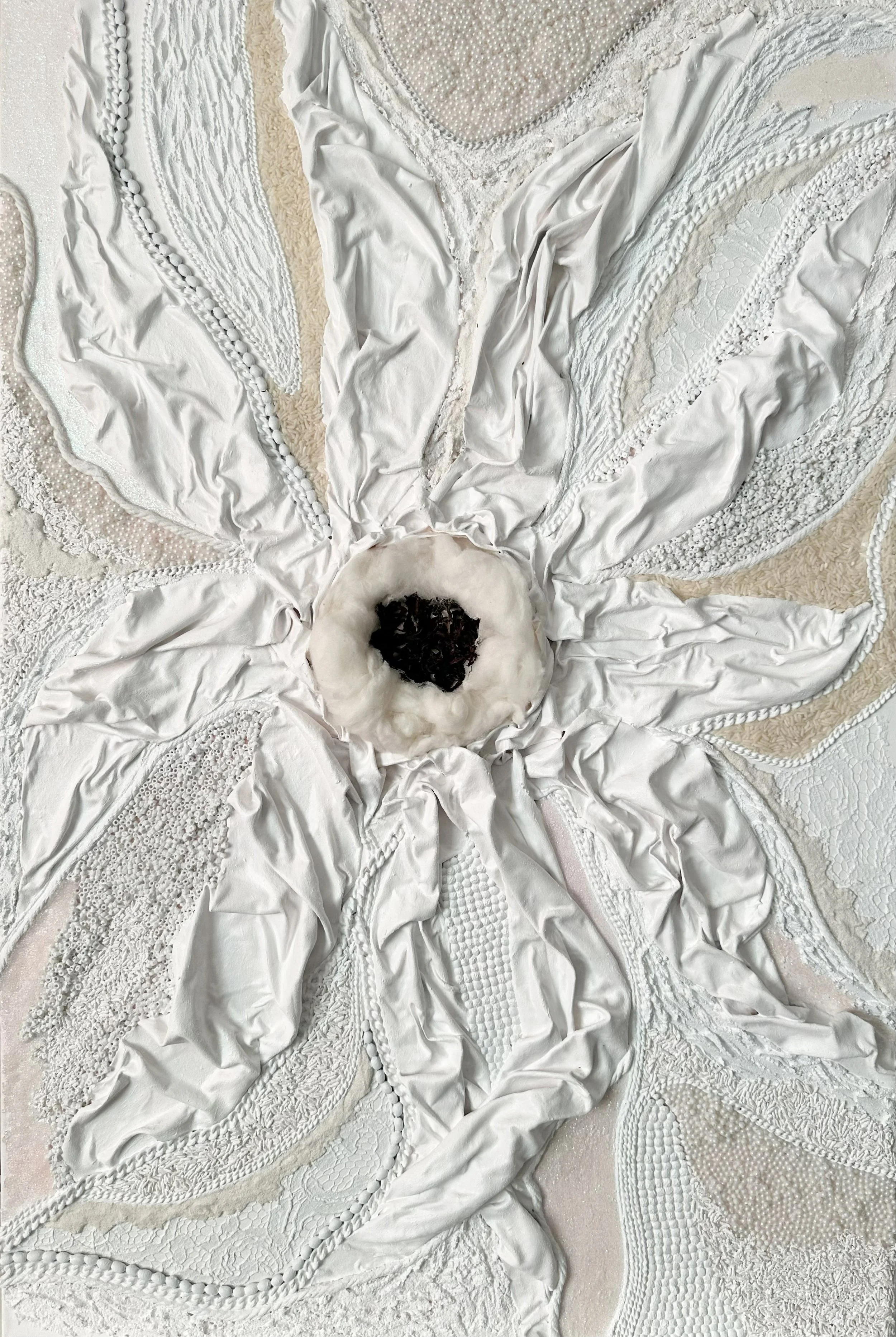
Greed: I Love You
36” x 24”
Acrylic Paint, Fabric, Beads, Chain, Cord, Deconstructed Mop Head, Beans, Lentils, Rice,
Sand (From Lewes Beach, DE), Sugar, Glitter, Dried Magnolia Leaves, Raw Cotton
2026
This mixed‑media work examines the violence, exploitation, and insatiable hunger at the heart of America’s cotton economy through a sculptural composition built from acrylic paint, fabric, beads, chain, cord, a deconstructed mop head, beans, lentils, rice, sand from Lewes Beach (DE), sugar, glitter, dried magnolia leaves, and raw cotton. Though the piece appears entirely white at first glance, faint touches of pink emerge from beneath the surface as a quiet but piercing reminder of the blood that once stained the cotton fields of the American South.
At the center of the work sits a cluster of raw cotton, encircled by dried magnolia leaves arranged to evoke the thorned, unforgiving stems of the cotton plant. This core becomes a symbolic wound: a site where innocence met brutality, where enslaved children were forced into labor so dangerous that pricked fingers, torn skin, and bloodied hands causing stain to the cotton flowers, were met not with care but with punishment. The whiteness of the piece, pristine, soft, almost serene, becomes a haunting contrast to the violence required to maintain that illusion. The hints of pink breaking through the white echo the hidden suffering that fueled an entire economy.
Chains, cords, and industrial materials woven throughout the composition connect this work to the broader themes explored in Wrath: Pound of Flesh and Twenty‑Five Percent: bondage, extraction, and the human cost of greed. The inclusion of non-perishable food items such as rice, beans, lentils, and sugar extends this symbolism into the present, referencing the ongoing crisis of food insecurity in under‑resourced communities, which is a legacy tied directly to the inequities forged during slavery and reinforced across generations.
The sand from Lewes Beach introduces another layer of meaning: a reminder of the shorelines where ships once arrived, carrying human beings whose bodies and futures would be consumed by the very crop represented at the center of this piece. The magnolia leaves, Southern, elegant, and sharp, embody the duality of beauty and harm, abundance and exploitation.
36” x 24”
Acrylic Paint, Fabric, Beads, Chain, Cord, Deconstructed Mop Head, Beans, Lentils, Rice,
Sand (From Lewes Beach, DE), Sugar, Glitter, Dried Magnolia Leaves, Raw Cotton
2026
This mixed‑media work examines the violence, exploitation, and insatiable hunger at the heart of America’s cotton economy through a sculptural composition built from acrylic paint, fabric, beads, chain, cord, a deconstructed mop head, beans, lentils, rice, sand from Lewes Beach (DE), sugar, glitter, dried magnolia leaves, and raw cotton. Though the piece appears entirely white at first glance, faint touches of pink emerge from beneath the surface as a quiet but piercing reminder of the blood that once stained the cotton fields of the American South.
At the center of the work sits a cluster of raw cotton, encircled by dried magnolia leaves arranged to evoke the thorned, unforgiving stems of the cotton plant. This core becomes a symbolic wound: a site where innocence met brutality, where enslaved children were forced into labor so dangerous that pricked fingers, torn skin, and bloodied hands causing stain to the cotton flowers, were met not with care but with punishment. The whiteness of the piece, pristine, soft, almost serene, becomes a haunting contrast to the violence required to maintain that illusion. The hints of pink breaking through the white echo the hidden suffering that fueled an entire economy.
Chains, cords, and industrial materials woven throughout the composition connect this work to the broader themes explored in Wrath: Pound of Flesh and Twenty‑Five Percent: bondage, extraction, and the human cost of greed. The inclusion of non-perishable food items such as rice, beans, lentils, and sugar extends this symbolism into the present, referencing the ongoing crisis of food insecurity in under‑resourced communities, which is a legacy tied directly to the inequities forged during slavery and reinforced across generations.
The sand from Lewes Beach introduces another layer of meaning: a reminder of the shorelines where ships once arrived, carrying human beings whose bodies and futures would be consumed by the very crop represented at the center of this piece. The magnolia leaves, Southern, elegant, and sharp, embody the duality of beauty and harm, abundance and exploitation.