
Exodus
48” x 36”
Acrylic, Gel Pen, Fabric, Burlap, Beads, Rocks, Metal, Glass, Styrofoam, Rice, Lentils, Tea, Metal Leaf, Thread, Cord, Feathers, Deconstructed Pine Cones, Seashells from Lewes Beach, DE, Deconstructed Mop Head, Cowry Shell, Grocery Bags, Glitter, Paper on Stretched Canvas
2026
This mixed‑media work traces a journey that is physical, spiritual, ancestral, and imagined all at once. Created with acrylic paint, gel pen, fabric, burlap, beads, rocks, metal, glass, styrofoam, rice, lentils, tea, metal leaf, thread, cord, feathers, deconstructed pine cones, seashells from Lewes Beach, Delaware, a deconstructed mop head, a cowry shell, grocery bags, glitter, and paper on stretched canvas, the piece fuses multiple modes of making including sculptural, painterly, symbolic, and narrative, into a single, expansive migration story.
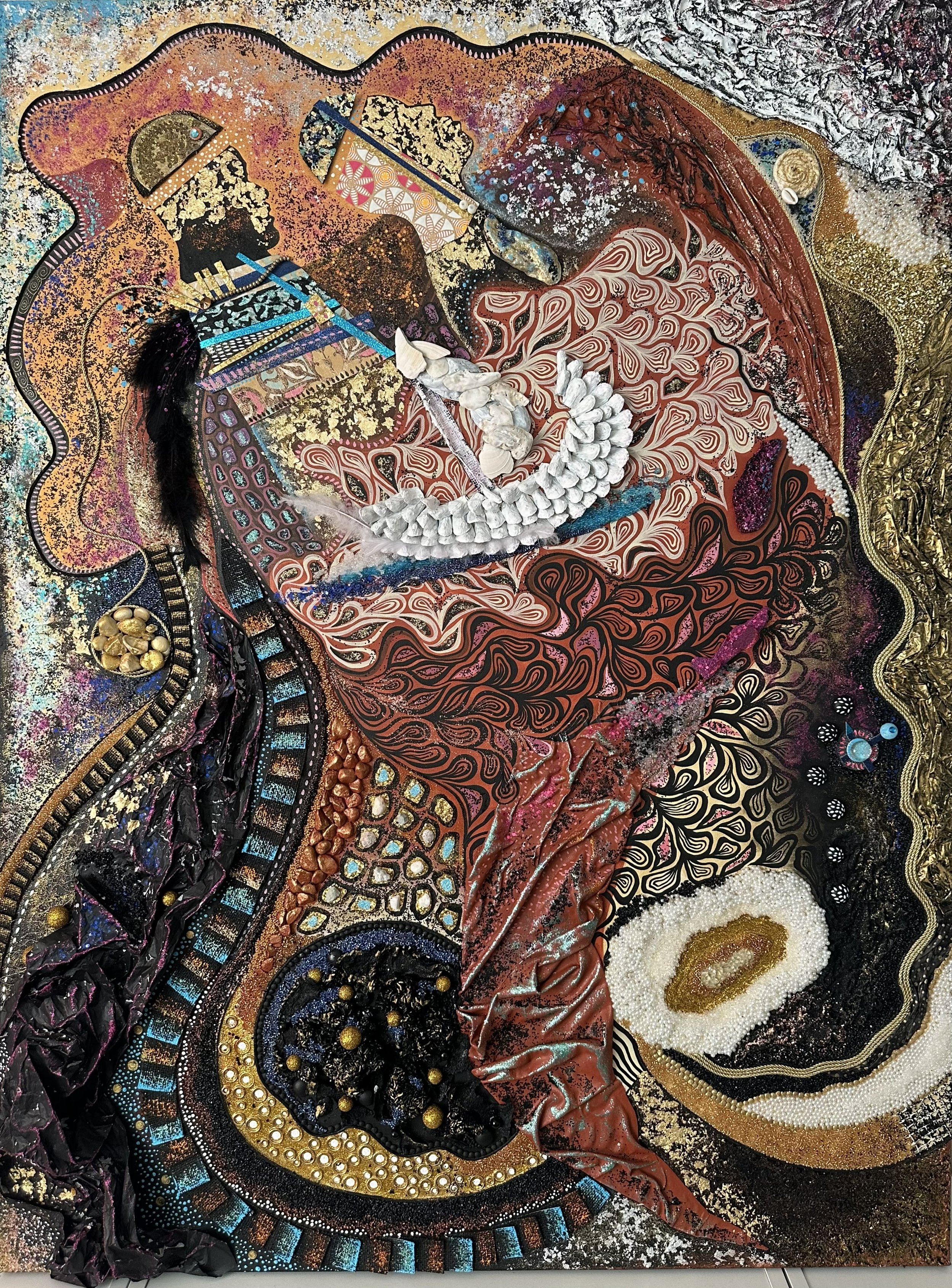
Originally conceived as a mermaid, the figure still lingers in the composition when the canvas is flipped horizontally: a white beaded and glass‑covered form marks the face, a dark mass above becomes the hair, and the body flows into a tail constructed from layered black burlap, blue and orange highlights, glitter, and sculpted parchment paper. Over time, the mermaid transformed into Olokun, the Yoruba orisha who governs the ocean’s depths. This deity was said to protect the enslaved Africans who were thrown or lept from ships during the Trans‑Atlantic Slave Trade, choosing the unknown over bondage. In this work, Olokun becomes both guardian and witness, a presence that holds the memory of those lost to the water, those who survived its crossing, and a continued protective entity as African-Americans navigate migration in present-day.
At the top of the piece, two figures travel together, their destination deliberately unclear. They may be sailing over the sea, as suggested by a small white ship crafted from a deconstructed pine cone gathered at East Potomac Park in Washington, D.C., a shoreline not far from the Georgetown port where enslaved people were once imported into the United States. Seashells collected with the artist’s daughter at Lewes Beach in Delaware form the vessel’s structure, tying the act of gathering, remembering, and creating to a lineage of mothers and daughters, ancestors and descendants.
The front figure is a woman leading the voyage; the man behind her occupies a space of intentional ambiguity. A rope circles his neck and connects to rocks, yet the rocks do not anchor him. The question becomes part of the narrative: Is he her captive, or is he being freed? Is she escaping with him, or escaping from him? The tension between liberation and captivity, agency and constraint, echoes the unresolved histories of forced migration, survival, and resistance.
This dynamic also speaks to the enduring struggles of women navigating power, protection, and partnership within systems built on domination. The woman’s leadership in this voyage becomes both an act of defiance and burden. She carries the weight of freedom while confronting the shadow of exploitation that has long defined the relationship between men and women under oppression. Her position at the front of the journey reflects the countless women who have led movements, families, and communities through peril, even as they bore the emotional and physical scars of patriarchal violence. In this way, the piece becomes not only a meditation on migration and survival, but also on the complex, often painful negotiations of love, trust, and autonomy that women endure in pursuit of liberation.
A single cowry shell, once used as currency to purchase enslaved Africans, anchors the piece in the economic realities of the slave trade, while a small pink glitter‑covered plane and celestial references gesture toward outer space, futurity, and imagined worlds beyond the violence of history. The work becomes a map of many migrations: across oceans, across time, across realms both earthly and cosmic.
Exodus is a story of departure without a promised arrival, of movement shaped by fear, hope, memory, and possibility. It is a meditation on leaving, on choosing the unknown, on the spiritual forces that accompany us, and on the complicated relationships we carry with us as we go. It is, in every sense, a journey.
48” x 36”
Acrylic, Gel Pen, Fabric, Burlap, Beads, Rocks, Metal, Glass, Styrofoam, Rice, Lentils, Tea, Metal Leaf, Thread, Cord, Feathers, Deconstructed Pine Cones, Seashells from Lewes Beach, DE, Deconstructed Mop Head, Cowry Shell, Grocery Bags, Glitter, Paper on Stretched Canvas
2026
This mixed‑media work traces a journey that is physical, spiritual, ancestral, and imagined all at once. Created with acrylic paint, gel pen, fabric, burlap, beads, rocks, metal, glass, styrofoam, rice, lentils, tea, metal leaf, thread, cord, feathers, deconstructed pine cones, seashells from Lewes Beach, Delaware, a deconstructed mop head, a cowry shell, grocery bags, glitter, and paper on stretched canvas, the piece fuses multiple modes of making including sculptural, painterly, symbolic, and narrative, into a single, expansive migration story.
Originally conceived as a mermaid, the figure still lingers in the composition when the canvas is flipped horizontally: a white beaded and glass‑covered form marks the face, a dark mass above becomes the hair, and the body flows into a tail constructed from layered black burlap, blue and orange highlights, glitter, and sculpted parchment paper. Over time, the mermaid transformed into Olokun, the Yoruba orisha who governs the ocean’s depths. This deity was said to protect the enslaved Africans who were thrown or lept from ships during the Trans‑Atlantic Slave Trade, choosing the unknown over bondage. In this work, Olokun becomes both guardian and witness, a presence that holds the memory of those lost to the water, those who survived its crossing, and a continued protective entity as African-Americans navigate migration in present-day.
At the top of the piece, two figures travel together, their destination deliberately unclear. They may be sailing over the sea, as suggested by a small white ship crafted from a deconstructed pine cone gathered at East Potomac Park in Washington, D.C., a shoreline not far from the Georgetown port where enslaved people were once imported into the United States. Seashells collected with the artist’s daughter at Lewes Beach in Delaware form the vessel’s structure, tying the act of gathering, remembering, and creating to a lineage of mothers and daughters, ancestors and descendants.
The front figure is a woman leading the voyage; the man behind her occupies a space of intentional ambiguity. A rope circles his neck and connects to rocks, yet the rocks do not anchor him. The question becomes part of the narrative: Is he her captive, or is he being freed? Is she escaping with him, or escaping from him? The tension between liberation and captivity, agency and constraint, echoes the unresolved histories of forced migration, survival, and resistance.
This dynamic also speaks to the enduring struggles of women navigating power, protection, and partnership within systems built on domination. The woman’s leadership in this voyage becomes both an act of defiance and burden. She carries the weight of freedom while confronting the shadow of exploitation that has long defined the relationship between men and women under oppression. Her position at the front of the journey reflects the countless women who have led movements, families, and communities through peril, even as they bore the emotional and physical scars of patriarchal violence. In this way, the piece becomes not only a meditation on migration and survival, but also on the complex, often painful negotiations of love, trust, and autonomy that women endure in pursuit of liberation.
A single cowry shell, once used as currency to purchase enslaved Africans, anchors the piece in the economic realities of the slave trade, while a small pink glitter‑covered plane and celestial references gesture toward outer space, futurity, and imagined worlds beyond the violence of history. The work becomes a map of many migrations: across oceans, across time, across realms both earthly and cosmic.
Exodus is a story of departure without a promised arrival, of movement shaped by fear, hope, memory, and possibility. It is a meditation on leaving, on choosing the unknown, on the spiritual forces that accompany us, and on the complicated relationships we carry with us as we go. It is, in every sense, a journey.