
For more than 20 years, Ralston Cyrus (@ralicyrus) has worked in what author Steven Pressfield calls a “shadow profession,” building a career as a user experience and software product designer in fast-paced agency and IT environments. Yet since childhood, he has been pulled toward something quieter and more essential: a human-centered artistic practice. Cyrus creates introspective portrait and figure works that reflect a long-held desire for simplicity, honesty, and inner clarity. Over the past decade, his work has been exhibited throughout the DMV and East Coast. His drawings and paintings aim to reveal the subtle truths within his subjects—still, contemplative moments that mirror his own search for peace. Through his work, Cyrus echoes the universal hero’s journey: the challenge of returning to one’s true self and honoring the creative spark that endures beneath every detour.
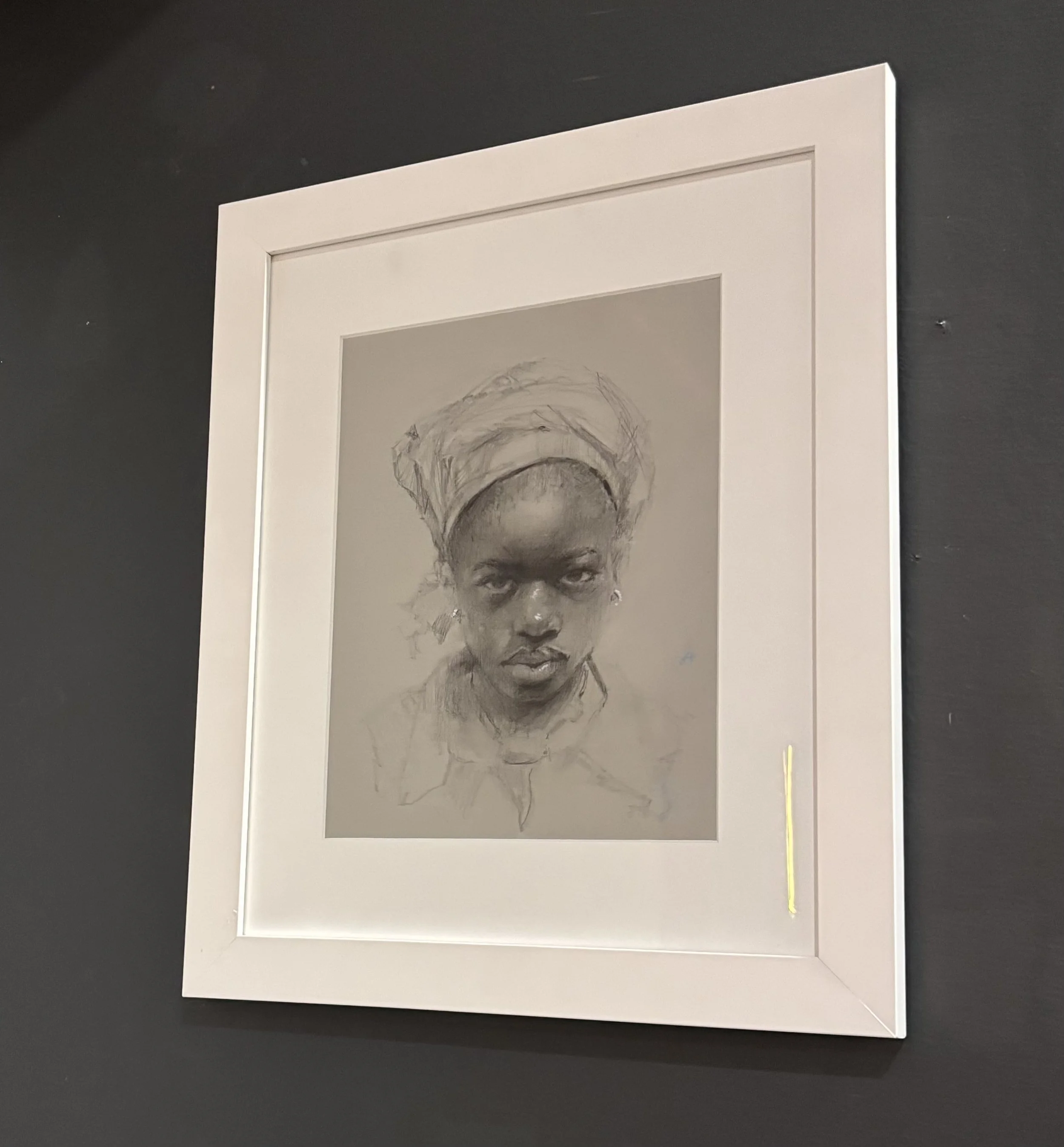
Dopamine Dreams extends the inquiry of my past exhibits, shifting from the quiet observation of human form to an exploration of the internal chemistry that shapes our notion of the divine and inner drives toward fulfillment. These portraits and figures explore the threshold between physical sensation and spiritual experience, where perhaps dopamine becomes both messenger and gatekeeper—an unseen current guiding desire, attention, memory, and the pursuit of meaning. Rendered in moments of stillness and chaos, each subject hovers between the tangible world and an inner, dreamlike plane. By pairing visceral human presence with subdued, atmospheric and astral spaces, the work invites viewers to consider how our physical minds influence our notion of transcendence. Dopamine Dreams asks whether enlightenment is a state we reach, or a transient shimmer we learn to notice.
Gia Harewood (@giametricart) is a curator, educator, and facilitator whose work centers the visibility, sustainability, and storytelling of artists across generations. Currently Curator in Residence at The Yard – Eastern Market in DC, she has organized solo and group exhibitions nationally, including recent shows at Arena Stage, Brentwood Arts Exchange, and DC Arts Center. With graduate degrees in English literature, Applied Theatre, as well as African American and Caribbean studies, she brings an interdisciplinary lens to curatorial work grounded in care, collaboration, and community engagement—skills used as a former Sherman Fairchild Fellow at The Phillips Collection and an Arts & Peacebuilding Culture Fellow at George Mason University’s Political Leadership Academy. Gia also designs and leads “Giametry Lessons,” a public program series focused on demystifying the business of art. When not curating or facilitating, she’s likely dancing, at a play, reviving her roller skating skills, or deep in an artist talk, podcast, and good book.
CURATORIAL STATEMENT. Black portrait artists have long used the genre to assert presence, dignity, and self-definition in a society that has historically denied Black people visibility and humanity. From early studio photographers and painters crafting images of Black life in the face of enslavement and segregation, to contemporary artists who challenge dominant narratives and expand the possibilities of representation, their work forms a vital lineage of cultural memory and artistic innovation. Through portraiture, artists such as Amy Sherald, Barkley L. Hendricks, Kerry James Marshall, Mickalene Thomas, and Elizabeth Catlett, reclaim the gaze, honor community, and create powerful archives that testify to Black resilience, creativity, and potency across generations. In Dopamine Dreams, Ralston Cyrus extends this legacy of portraiture as both reverence and justice—reverance for the musical genius of famous figures such as Roy Ayers, Quincy Jones, Minnie Riperton, and Nina Simone and justice for the humanity and beauty that lies within everyday people. By eliminating definitive backgrounds in each work, Cyrus turns down the noise of any potential distraction and forces viewers to directly focus on the figure and primarily their face; there is nowhere else to look—even if the subject is not looking back. However, unlike the direct gaze in Amy Sherald’s signature portraits, the eyes of these subjects are looking down, looking away, sometimes straight ahead, or even completely closed. In this way, each expression evokes a sense of deep thought. Cyrus centers interiority and peace. While no one is smiling, there is still a calm presence and meditative, deep-breath energy around the room. As he says about his subjects, “this is a whole person with a soul.” Therefore, he invites the audience to insert these faces into a genre historically reserved for the elite. He also wants us to pay attention to more unsung heroes. We can only guess what pleasure, motivation, or reward these figures dream of. Given the social landscape of increased anti-Blackness and dehumanization, perhaps they dream of a world that does not lump large groups of Black people into degraded piles or a time when their accomplishments and history are not being minimized or erased. We cannot be sure. Yet one thing is for certain: this impeccable image-making demonstrates a rich artistic vocabulary and mastery of craft that is above all else, simply beautiful. And the idea of Black beauty combined with complex humanity is perhaps the most radical dream of all.